
The short answer: a very long time
Dental implants are the most durable tooth replacement option available. The titanium post that anchors the implant into your jawbone is designed to last a lifetime – and in the majority of patients, it does. The crown attached on top has a shorter lifespan, typically 15 to 25 years depending on wear and maintenance. Understanding the difference between these two components is key to setting realistic expectations about what you’re investing in.
Ontario patients considering implants often ask us whether the cost is justified given longevity concerns. The evidence is clear: with proper care and an experienced implant dentist, dental implants outlast every alternative – including bridges, which typically need replacement after 10 to 15 years, and dentures, which require replacement every 5 to 7 years.
The implant post vs. the crown – two different lifespans
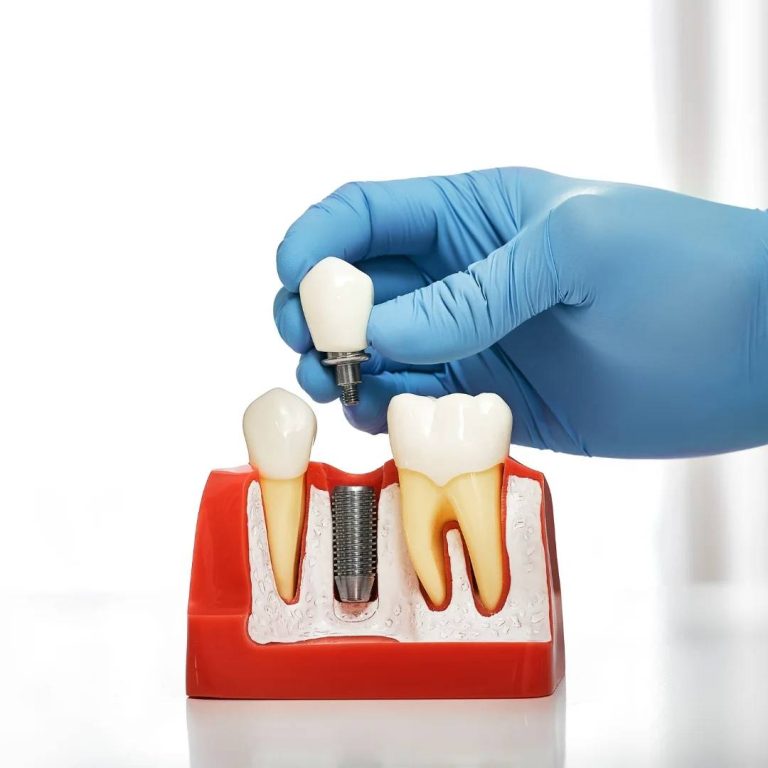
A dental implant is made up of three components: the titanium post (implanted into the jawbone), the abutment (the connector), and the crown (the visible tooth on top). Each has a different expected lifespan, and it’s important not to confuse them.
The titanium post is considered a permanent fixture. Once osseointegration is complete – meaning the post has fully fused with your jawbone – it functions as a permanent tooth root. Studies following implant patients for 20 and even 30 years show that the vast majority of posts remain stable and functional. Failure rates after successful osseointegration are extremely low, typically under 1% per year.
The crown is exposed to the same daily wear as your natural teeth – chewing, grinding, and temperature changes all affect it over time. Most high-quality porcelain or zirconia crowns last 15 to 25 years before needing replacement. When a crown does need replacing, it’s a straightforward procedure – the post and abutment remain in place, and a new crown is simply fitted on top.
What the clinical research actually shows
Dental implants have one of the most thoroughly studied long-term track records of any dental or surgical procedure. Here’s what the evidence shows:
- →10-year success rate: 95 to 98% across multiple large-scale studies, making implants one of the most reliable surgical procedures in modern medicine.
- →20-year data: Long-term studies show survival rates of 90 to 95% at 20 years, with most failures occurring in the early osseointegration phase rather than after years of stable function.
- →30-year data: Brånemark’s original implant patients – the first humans to receive modern titanium implants in the 1960s – retained functioning implants for 30 or more years.
These numbers reflect patients across all age groups, health profiles, and implant types. Success rates for healthy, non-smoking adults with good bone density are even higher.
Factors that affect how long your implant lasts
Implant longevity isn’t just about the implant itself – it’s significantly influenced by patient factors, lifestyle choices, and the quality of the original placement. Here’s what matters most.
Oral hygiene
The most controllable factor. Implants cannot decay, but the gum tissue surrounding them can develop a condition called peri-implantitis – essentially gum disease around the implant – if plaque is allowed to build up. Left untreated, peri-implantitis causes bone loss around the implant and is the leading cause of late implant failure. Brushing twice daily, flossing, and attending regular professional cleanings dramatically reduces this risk.
Smoking
Nicotine restricts blood flow to the gum tissue, impairing healing and osseointegration. Smokers have significantly higher implant failure rates than non-smokers. Quitting smoking before and after implant placement is the single most impactful lifestyle change a patient can make to improve long-term outcomes.
Bruxism (teeth grinding)
Patients who grind their teeth at night place additional stress on the crown and implant post. This doesn’t disqualify you from getting implants, but it does mean your dentist will likely recommend a custom night guard to protect your investment and extend crown lifespan.
Placement quality
The experience and skill of your implant dentist directly affects long-term success. Precise placement – positioning, angle, and depth – determines how well the implant integrates with bone and how evenly biting forces are distributed. This is one of the most important reasons to choose an experienced implant dentist over one who places implants only occasionally.
Implant brand and materials
Premium implant systems from manufacturers like Nobel Biocare and Straumann have decades of documented clinical outcomes behind them. Generic implant systems may cost less but have shorter track records and, in some cases, lower documented success rates. At My Dental Implant, we use only clinically validated implant systems with proven long-term data.
Overall health and bone density
Conditions that affect healing – uncontrolled diabetes, autoimmune disorders, or certain medications like bisphosphonates – can influence osseointegration and long-term stability. Most of these conditions are manageable with the right preparation and careful oversight from your dentist, but they are worth discussing openly at your consultation.
The titanium post in a well-placed implant is expected to last a lifetime. The crown on top will likely need replacing once – around the 15 to 25 year mark. Across a 20-year horizon, this makes implants significantly more cost-effective than dentures or bridges when you account for their replacement cycles.
How implant longevity compares to alternatives
One of the most overlooked aspects of the implant-vs.-alternatives conversation is what happens over time – not just upfront. Here’s how the lifespan of each option compares for a single missing tooth:
- →Dental implant: Titanium post lasts a lifetime. Crown replaced once at approximately year 20. Total cost over 20 years: roughly $6,000.
- →Dental bridge: Typically lasts 10 to 15 years before needing replacement. Requires grinding down healthy adjacent teeth. One replacement needed over 20 years, plus potential remedial work on those adjacent teeth. Total cost over 20 years: roughly $8,000 to $12,000.
- →Full dentures: Require replacement every 5 to 7 years, relining every 1 to 2 years, and daily adhesive. Three or more replacements over 20 years. Total cost over 20 years: roughly $15,000 to $20,000 when all costs are included.
The pattern is clear: implants cost more on day one and less over a lifetime.
How to make your implant last as long as possible
The good news is that the most important factors for implant longevity are largely within your control. Follow these guidelines and your implant has every chance of lasting the rest of your life.
- →Brush twice daily with a soft-bristle toothbrush. Electric toothbrushes are effective and gentle on gum tissue.
- →Floss daily around the implant. Interdental brushes or a water flosser are also effective options for cleaning around the implant post.
- →Attend professional cleanings every six months. Your hygienist uses instruments safe for implant surfaces and monitors the surrounding tissue for early signs of peri-implantitis.
- →Wear a night guard if you grind your teeth. This protects both the crown and the implant post from excessive force during sleep.
- →Avoid using your implant as a tool. Opening packages, cracking nuts, or chewing ice can damage the crown just as they would a natural tooth.
- →Don’t smoke. If you do, quitting before and after implant placement significantly improves your long-term success rate.
The bottom line
A dental implant placed by an experienced implant dentist in a healthy patient is designed to last a lifetime – and the clinical evidence over 50 years of implant dentistry backs that up. The crown will likely need replacing once, but the foundational post is a permanent investment in your oral health and quality of life.
If you’re considering dental implants in Ontario and want to understand what longevity looks like for your specific situation – your bone density, health profile, and lifestyle – the best next step is a free consultation with Dr. Sherghin or Dr. Chang. You’ll leave with a clear picture of what to expect, what it costs, and what your insurance covers.