
By: Hesham Sherghin
Getting a dental implant is a milestone, and most people leave the appointment feeling a mix of relief and uncertainty. The hard part is behind you. But a very reasonable question follows close behind: what happens now?
The honest answer is that an implant is not a finish line. It is more like getting a new set of tires – excellent, durable, engineered to last a long time, and entirely dependent on how they are looked after. This guide walks through what to expect in the days after surgery, what the months ahead look like, and what your daily routine should look like for years to come.
The first two weeks
Your body is doing something remarkable in this period: it is knitting living bone directly onto a titanium surface. Your job is mostly to stay out of its way.
Expect some swelling, which usually peaks around day two or three and then settles. Bruising is normal and can appear a surprising distance from the surgical site, sometimes travelling down toward the jawline. Mild oozing on the first day is expected. Discomfort is typically manageable and improves steadily rather than suddenly.
A few practical points for this stretch:
Eat softer, and chew elsewhere. Keep food away from the surgical site for the first week or two. Soup, eggs, pasta, fish, and yogurt are all easy wins. Avoid anything crunchy or seedy that can lodge in the healing tissue.
Do not smoke or vape. This is the single most damaging thing you can do to a healing implant. Nicotine narrows blood vessels and starves the site of exactly what it needs. If there was ever a moment to pause, this is it.
Keep the area clean, gently. Do not avoid brushing the site out of fear – plaque is far more harmful than careful cleaning. Use a soft brush around the area and follow any rinse instructions you were given.
Skip the straw and the workout. Suction and heavy exertion both work against a fresh clot. Give it a few days.
Call the office if swelling worsens after day three rather than improving, if you develop a fever, if numbness persists well beyond the expected window, or if something simply feels wrong. Early problems are almost always easier to solve than late ones.
Why it takes months, not weeks
An implant is not screwed in and immediately loaded with chewing force. Bone needs time to grow onto and around the implant surface, a process called osseointegration. Depending on where the implant is, the quality of the bone, and whether grafting was needed, this takes anywhere from about six weeks to six months.
During this period you may have a small healing cap visible at the gumline, a temporary tooth, or nothing at all, depending on your case. If you were given a temporary, treat it as exactly that: it is there to hold space and let you function, not to be tested. Temporaries can and do come loose, and that is inconvenient rather than alarming.
The waiting is the part patients find hardest. It helps to remember that the timeline is not padding – it is the difference between an implant that lasts decades and one that fails in its first year.
The most important thing to understand
Here is the point that gets missed most often, and it matters more than anything else in this article.
An implant cannot get a cavity. That is genuinely good news. But the gum and bone around an implant can absolutely get gum disease, and when they do, it tends to progress faster and more quietly than it does around a natural tooth.
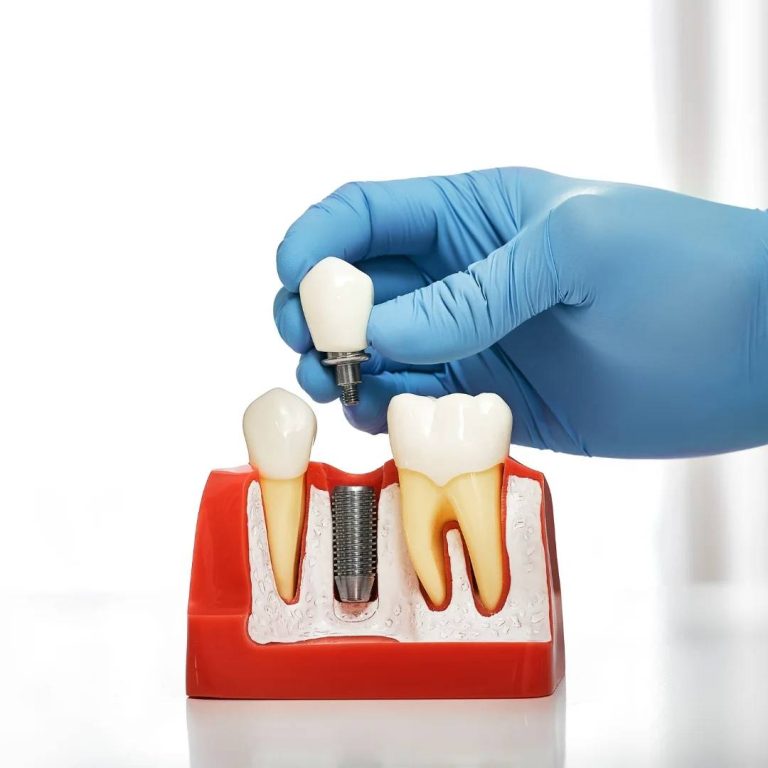
The reason comes down to anatomy. A natural tooth is suspended in its socket by a thin ligament, richly supplied with blood vessels and nerve endings. That ligament acts as both a shock absorber and an alarm system. An implant has no ligament – it is fused directly to bone. It has a weaker seal against bacteria, less blood supply to fight infection, and no early warning signal. An implant can be losing bone for a long time before you feel anything at all.
Early inflammation of the gum around an implant is reversible with good cleaning and a professional visit. Once bone begins to disappear, it becomes considerably harder to treat and does not fully grow back. The whole strategy, therefore, is to catch things early – which is why the cleaning routine below is not optional advice.
Your daily routine, by type of restoration
A single crown
Brush twice daily as normal, and clean between the implant crown and its neighbours every single day. Regular floss works, though many people find floss picks, soft interdental brushes, or a water flosser easier and more likely to actually get used. The best tool is the one you will use consistently.
One thing to watch: food packing between the crown and the tooth beside it. If you find yourself digging at the same spot after every meal, mention it. That is usually a contact that has drifted and can be corrected.
A bridge on implants
A bridge has a section that spans a gap and sits just above the gum, and plaque collects underneath it where a toothbrush cannot reach. Threading floss, floss designed with a stiff end, or a water flosser aimed along the underside is essential here. Once you have the technique, it takes under a minute. Some bridges are created to be very tight below the gum line and no flossing is necessary underneath the fake tooth. Your dental professional will advise you to floss, or not, underneath the bridge.
A fixed full-arch bridge
If you have a full set of teeth fixed onto several implants, your cleaning routine is genuinely different from anyone else’s and deserves proper attention.
The critical zone is the underside – the space between the bridge and your gum tissue. Nothing you do from the chewing surface reaches it. A water flosser used along that channel, combined with threading floss passed underneath and drawn back and forth, is the standard approach. Most patients do this once daily, usually at night, and it becomes routine within a few weeks.
Because this design is harder to clean than any other, professional visits tend to be more frequent, and your dentist will periodically remove the bridge entirely to clean and inspect underneath it. This is normal maintenance, not a sign that something is wrong.
A removable overdenture
If your denture clips onto implants and you take it out, you have two things to clean rather than one.
Remove the denture and clean it thoroughly outside your mouth – brush it with a denture brush and non-abrasive cleaner, not regular toothpaste, which is scratchy enough to create places for bacteria to settle.
Clean around each implant attachment in your mouth separately, with a soft brush, working right around the little post that sits above the gum.
Take the denture out at night unless you have been told otherwise. Tissue that is covered around the clock does not stay healthy.
The plastic or nylon inserts that grip the attachments are wear items, much like brake pads. They loosen over time and are meant to be replaced periodically. A denture that has become loose is usually a five-minute fix, not a failure.
Professional maintenance
Most implant patients are seen every three to six months, with the interval set by how your gums respond and how complex the restoration is. These visits are doing more than a routine polish.
Cleaning with the right instruments. Implant surfaces can be scratched by standard steel scalers, and a scratched surface holds bacteria. Hygienists may use specific instruments for this reason.
Measuring and probing. Gentle measurements around each implant, tracked over time, catch bone changes long before you would notice anything.
Periodic X-rays. A baseline image taken when your final restoration is fitted is invaluable, because everything afterwards is compared against it.
Checking the hardware. Implant restorations are held together by small screws that can loosen slightly with years of chewing. Catching and re-tightening a loose screw early prevents it from fracturing.
Checking your bite. Natural teeth move a little through life; implants do not. Over years, the bite can shift so that the implant takes more force than it should. Small adjustments protect it.
What puts an implant at risk
Smoking. The clearest and most consistent risk factor, both during healing and for the long term.
Inconsistent cleaning. The most common cause of late problems, and the most preventable.
Skipped maintenance visits. Because problems around implants are quiet, the visit is often the only way they get found in time.
Grinding and clenching. Implants have no shock absorber. If you grind, a night guard is a genuinely worthwhile investment in protecting your restoration.
Poorly controlled diabetes. Well-managed diabetes is not a barrier to implants at all. Poorly controlled blood sugar meaningfully slows healing and raises infection risk.
Very hard foods. Ice, popcorn kernels, and hard candy chip porcelain. Using your teeth to open packaging does the same.
When to call
At any point after healing, get in touch if you notice bleeding when you clean around the implant, gums that are red, puffy, or tender, a persistent bad taste or odour, any looseness or clicking, a chip in the porcelain, or food packing that suddenly starts happening where it did not before.
None of these mean the implant is lost. Every one of them is easier to handle early. The instinct to wait and see whether it settles is understandable, and it is the instinct worth resisting.
What to expect over the long run
Modern dental implants have a strong track record, with the large majority still functioning well after ten years and many lasting far longer than that. Those numbers, however, come from patients who cleaned around them and kept their maintenance appointments. They are not a guarantee that comes in the box.
It is also worth knowing that the implant itself and the tooth attached to it have different lifespans. The implant in the bone is the durable part. The crown, bridge, or denture on top is a working component that experiences daily wear, and it may need repair, refinishing, or replacement at some stage while the implant underneath continues to serve perfectly well. That is normal, expected, and not a sign that anything went wrong.
The bottom line
An implant gives you back something you had lost – the ability to chew properly, speak clearly, and smile without thinking about it. What it asks in return is fairly modest: clean around it every day, come in for your maintenance visits, and speak up early when something feels different.
Do those three things, and there is every reason to expect your implant to serve you well for a very long time.
Frequently Asked Questions
Can a dental implant get a cavity?
No, an implant itself cannot get a cavity because it isn’t made of natural tooth material. However, the gum and bone around it can still develop gum disease, and because an implant lacks the ligament and blood supply a natural tooth has, that disease can progress faster and with fewer warning signs.
How long does it take for a dental implant to fully heal?
Full healing, known as osseointegration, is the process of bone growing onto and around the implant surface. Depending on the implant’s location, bone quality, and whether grafting was needed, this typically takes anywhere from about six weeks to six months before the implant can safely handle normal chewing force.
How do I clean around a dental implant every day?
The routine depends on the type of restoration. A single implant crown needs regular brushing plus daily cleaning between it and neighbouring teeth, using floss, floss picks, or a water flosser. Bridges and full-arch restorations need extra attention underneath, where a toothbrush can’t reach, usually with threading floss or a water flosser aimed along that channel. Removable overdentures need to be taken out and cleaned separately from the implant attachments in the mouth.
What are the warning signs of a problem with a dental implant?
Contact your dentist if you notice bleeding when cleaning around the implant, red or puffy gums, a persistent bad taste or odour, any looseness or clicking, a chip in the porcelain, or new food packing around the site. None of these automatically mean the implant has failed, but they’re all easier to treat the earlier they’re caught.
Does smoking affect dental implant success?
Yes, smoking is one of the most consistent risk factors for implant problems, both during initial healing and over the long term. Nicotine narrows blood vessels and reduces the blood supply the healing site needs, which is why avoiding smoking and vaping matters most in the weeks right after surgery.
How long do dental implants last?
Modern dental implants have a strong track record, with most still functioning well after ten years and many lasting considerably longer. That outcome depends on consistent daily cleaning and regular maintenance visits. The implant itself and the crown, bridge, or denture attached to it also age differently – the restoration on top may need repair or replacement over time even while the implant in the bone continues to function normally.
This article is general education and is not a substitute for advice about your own situation. Your dentist’s instructions always take priority, because they are based on your specific case.